Building Without Code: Exploring Vibe Coding and AI Innovation at Tuck
By Tuck Communications
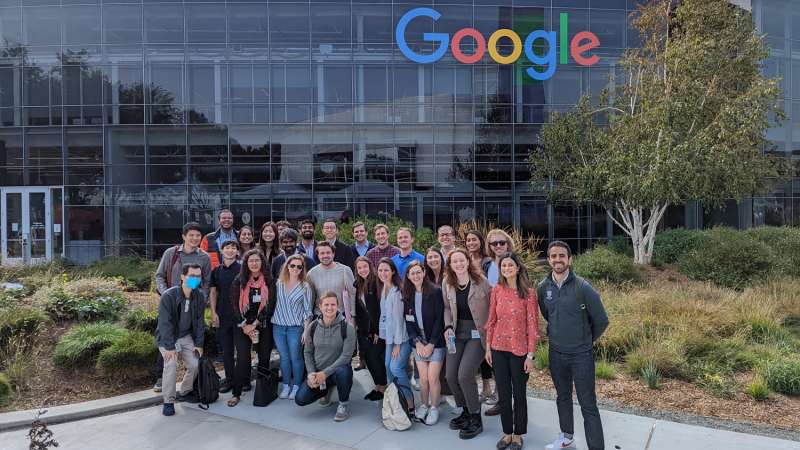
At the intersection of technology and creativity, vibe coding invites users to build software not through lines of code, but through dialogue with AI—making app development more accessible to those without a programming background. A recent workshop from the Center for Digital Strategies gave Tuck students the chance to explore this approach firsthand.
Participants Cecily Power T’27 and Ariadne Kaylor T’27 share what they built, what they learned, and how they see AI shaping the future of business.

Cecily Power T’27
Hometown: Newton, MA
Undergrad: Colgate University
Undergrad major: Computer Science
Role prior to Tuck: Product Manager
What did you create during the vibe coding session and what were your key takeaways?
I used an AI tool called Vercel to build an app that helps MBA students prepare for interviews. The app lets students search for a company, review a recommended list of resources, and take a short quiz. It creates a structured way to learn about a company before a behavioral interview.
What amazed me was how quickly I could bring the idea to life. Within a couple of hours I had a working prototype, which is something that used to take days or weeks in my previous role as a product manager. That said, the tool didn’t get everything right. It took several iterations to build what I envisioned and some features, like the quiz, never quite worked the way I wanted.
Vibe coding tools like this are incredible for exploring ideas and fast prototyping. Still, manual coding and engineering expertise are essential to polish the final product and ensure the app is secure and production-ready.
How did this hands-on experience shape the way you think about AI, its potential and its challenges, in business and leadership?
My vibe coding experience gave me a new sense of confidence in turning my entrepreneurial ideas into reality. I saw that vibe coding tools are low cost, easy to use, and can generate working prototypes in a few hours with no deep technical skills required. It has never been easier to bring a product idea to life, and I’d encourage anyone to try vibe coding, whether it’s to solve a problem at work or to explore a side project (that could even generate some revenue).
At the same time, I was reminded that AI still needs a lot of human guidance. When we let an AI tool write the code, we are depending on its ability to accurately interpret our instructions. Learning how to communicate with AI tools is so important. It’s the key to efficiently and successfully getting the results we want.
How else do you interact with AI at Tuck?
At Tuck, I use AI chatbots to support me in a whole range of tasks. ChatGPT and Claude assist me with everything from understanding tricky course topics to prepping for interviews to planning my sister’s bachelorette trip.
In what ways do you think experimenting with AI at Tuck prepares you for your future career, regardless of industry or role?
Across industries and roles, AI is changing everything from how we make decisions, to how we collaborate, and how we create value. I think one of the best ways to prepare for this shift is by learning to adapt with curiosity and confidence. At Tuck, I believe experimenting with AI tools is helping me prepare to successfully navigate the uncertainty that comes with new and transformative technology.

Ariadne Kaylor T’27
Hometown: Seattle, WA
Undergrad: Cal Poly
Undergrad Major: Psychology
Role prior to Tuck: Clinical Research Coordinator at Mass General Hospital
Can you briefly explain what vibe coding is for people who may not know?
While I’m still learning about the nuances of the term, my understanding is that vibe coding refers to coding with the help of a large language model (LLM). It allows anyone to create applications by using plain–language prompts to generate code through an AI tool, essentially making coding more accessible to those without a programming background.
What did you create during the vibe coding session? And what were your key takeaways or learnings?
When I was an athlete on my college’s Cheer & STUNT team, I noticed how challenging it was to choreograph the movement of 30+ people through different sections of a routine and across the mat. I wanted to build a tool that could help coaches visualize routine transitions without spending hours on trial-and-error with the entire team.
Using vibe coding, I created a web app to digitize this process. The app lets coaches represent each athlete as a circle on a virtual “mat” and drag them to different locations. A timeline along the bottom runs for 2.5 minutes (the typical length of a competition cheer routine) and allows users to set each athlete’s position on the mat at different time markers. Once the routine has been set, the coach can click “play” to watch the athletes move between different sections of the routine, noting any points of congestion where transitions may need adjustment.
How did this hands-on experience shape the way you think about AI—its potential, and its challenges—in business and leadership?
I was honestly amazed by how easy it was to build the app, but I also noticed how intentional I needed to be with my prompts to get the results I was looking for. It forced me to slow down and describe, very literally, details that might feel intuitive—like instructing the AI to change the cursor from an arrow icon to a hand icon when hovering over a circle. The experience reinforced that while AI is an amazing tool, its power ultimately lies in how effectively humans can harness and direct it.
In what ways do you think experimenting with AI at Tuck prepares you for your future career, regardless of industry or role?
I think that right now AI plays a role in almost any job, not just those in tech. Having a foundational understanding of AI and its strengths and limitations will help me work more effectively and deliver impactful solutions for clients.
Beyond AI itself, I think interacting with any new type of technology is good for creativity—it forces you to learn a new syntax and think in ways you’re not used to. Even if AI evolves into something new or falls “out of style,” the skills I’ve gained will continue to be valuable as I learn and adapt to future innovations.
Stay Connected
Create a profile to learn more about Tuck and receive news and updates
You Might Also Like